

While your iron won’t instantly destroy a part, higher temperatures transfer heat much faster. Using a high-temperature iron—especially with lead-free solder—can be risky. You can fry a pot, and prolonged excessive heat can melt the resin in the fiberglass of switches or output jacks.
Before You Mod: Check Your T.O.N.E.S.
![]()
![]() We've learned the hard way, so you don't have to. Here are five key considerations before you dive into your install. Just remember – check your T.O.N.E.S.
We've learned the hard way, so you don't have to. Here are five key considerations before you dive into your install. Just remember – check your T.O.N.E.S.
TEST FIT EVERYTHING

Here’s a simple but mission-critical step that can save you serious time, frustration, and a few choice words. Before you even plug in your soldering iron, test-fit all your new components. Confirm the following:
-
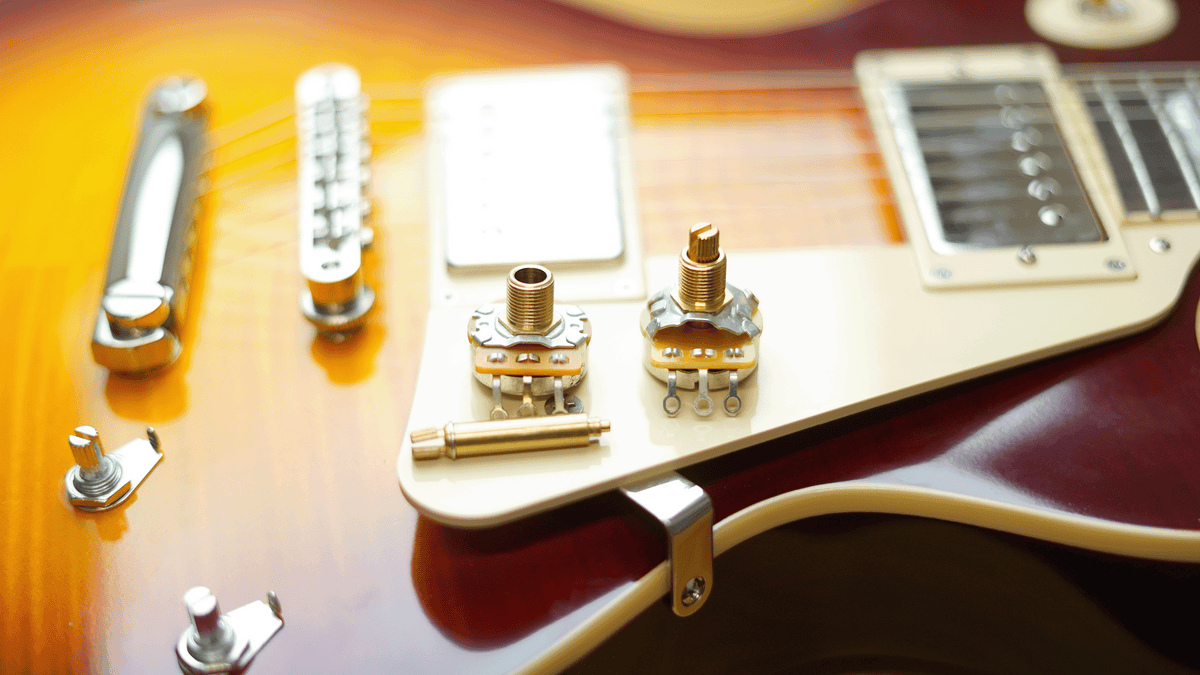
Potentiometer Fit: Especially with push-pull pots, Make sure your pots clear the control cavity and have enough thread length to secure properly. This is especially important with push-pull pots. A pot that doesn't fit is a huge bummer – particularly when it's already been wired up!
-
Knob Compatibility: Double-check that the knobs’ internal splines match the pots’ shaft splines. Installing incompatible knobs—or forcing compatible ones the wrong way—can damage your kit. Learn more about the proper knob technique here.
-
Cavity Clearance: Ensure all components and wiring fit comfortably inside the cavity without creating a shorting risk. If it looks cramped now, it won’t magically improve once the lid’s on.
-
Pickup Lead Suitability: Confirm the pickup leads are the correct type for your kit. The right wires make life easier. The wrong ones make life educational.
Performing these checks before soldering is essential. Future-you will be grateful.
ORIENTATION & PHASE FIT

It's essential to confirm all your pickups are “speaking the same language.” Check their specifications to confirm polarity, or make phase swapping easier by ordering the correct pickup leads—4-conductor for humbuckers and 2-conductor for single coils.
Mixing signals without checking phase is like wiring in a polite argument: technically they'll be connected... but nobody’s happy. Learn more about this here
NEVER OVERTIGHTEN NUTS -

It may seem obvious to tighten the pot nut until it’s “snug,” but that word gets abused. “Snug” does not mean cranked down like you’re securing a submarine hatch.
Rule of thumb: Tighten the mounting nut just enough to prevent the pot from moving. Hand-tighten first, then give it no more than a quarter-turn with a wrench. That’s it!
EXPECT A BIT OF NOISE -

Not all noise means something’s wrong. In a passive circuit, some level of noise is completely normal. Of course "normal" is subjective, but how much noise to expect largely depends on your pickups (single coils, non-potted pickups, humbuckers with unbalanced winds) and the complexity of your wiring.
If the noise doesn’t sound like touching the tip of a cable and it disappears when you touch a metal part (like the strings), it’s totally normal.
You can reduce internal noise by shielding your guitar’s cavity, or externally with a noise gate pedal. But there’s no single “magic bullet” that eliminates noise entirely in a passive circuit. It's just the nature of the beast.
SOLDER SMARTLY
Soldering is an art form unto itself - but you don't need to be a master to get the job done. Keep the following in mind – and be careful while you're at it!
Solder Smarter, Not Harder
For best results, take your time. Tin your wires, not your lugs. Use a clean, properly heated soldering iron.
The Golden Rule: Use Minimal Solder.
Excess solder makes heating difficult and significantly increases the risk of frying or melting components. More solder does not equal more better.
Critical Time Limits for Soldering:
-
Pots, Switches, and Jack Lugs: NEVER solder these components for more than 4 seconds at a time. If you’re running high heat (700–800°F), keep contact under 2 seconds.
-
Multiple Attempts: If you need more than one pass, wait 30 seconds between attempts. This allows the component to cool—and your iron to return to proper temperature.
Understanding Heat Limits:
Maximum soldering time is directly related to your iron’s temperature: the hotter the iron, the shorter your contact time must be.
Most components (like potentiometers) have a maximum rated heat resistance. For example, CTS (a ubiquitous pot) specifies 350°C (662°F) for 3 seconds on the lug.
Example of CTS' datasheet


Real switch from a customer
In short: controlled heat, minimal solder, steady hands. This is electronics—not a barbecue.
To round it out – take your time, respect the components, and think one step ahead. A careful build always outperforms a rushed one—and the goal isn’t just to make sound, it’s to make it reliably. Mind your T.O.N.E.S. and your guitar will reward you every time you plug in.
Read more
Knob The Number One Killer of Guitar Pots (And How to Stop It!) Knurled Edition
In the world of guitar maintenance and modding, replacing a potentiometer—or "pot"—is inevitable, whether as an upgrade or due to wear. A crucial yet frequently overlooked point is that the leading...
Read more
So You Want to Mod Your Telecaster: 5 Strategies to Get More Out of Your Tele
The Fender Telecaster is the ultimate "blank canvas" of the guitar world. Its simple, robust design makes it incredibly easy to tinker with, but before you break out the soldering iron, you need to...
Read more
1 comment
Great information. The fry a pot is very revealing!
Rickey B
Leave a comment
This site is protected by hCaptcha and the hCaptcha Privacy Policy and Terms of Service apply.